The Party committee system is an important Party institution for ensuring collective leadership and preventing any individual from monopolizing the conduct of affairs. It has recently been found that in some (of course not all) leading bodies it is the habitual practice for one individual to monopolize the conduct of affairs and decide important problems. Solutions to important problems are decided not by Party committee meetings but by one individual, and membership in the Party committee has become nominal. Differences of opinion among committee members cannot be resolved and are left unresolved for a long time. Members of the Party committee maintain only formal, not real, unity among themselves. This situation must be changed. From now on, a sound system of Party committee meetings must be instituted in all leading bodies, from the regional bureaus of the Central Committee to the prefectural Party committees; from the Party committees of the fronts to the Party committees of brigades and military areas (sub-commissions of the Revolutionary Military Commission or leading groups); and the leading Party members' groups in government bodies, people's organizations the news agency and the newspaper offices. All important problems (of course, not the unimportant, trivial problems, or problems whose solutions have already been decided after discussion at meetings and need only be carried out) must be submitted to the committee for discussion, and the committee members present should express their views fully and reach definite decisions which should then be carried out by the members concerned.... Party committee meetings must be divided into two categories, standing committee meetings and plenary sessions, and the two should not be confused. Furthermore, we must take care that neither collective leadership nor personal responsibility is overemphasized to the neglect of the other. In the army, the person in command has the right to make emergency decisions during battle and when circumstances require.
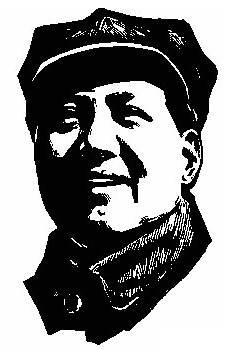
Without a people's army the people have nothing.
The revolutionary war is a war of the masses; it can be waged only by mobilizing the masses and relying on them.
People of the world, unite and defeat the U.S. aggressors and all their running dogs! People of the world, be courageous, dare to fight, defy difficulties and advance wave upon wave. Then the whole world will belong to the people. Monsters of all kinds shall be destroyed
All reactionaries are paper tigers. In appearance, the reactionaries are terrifying, but in reality they are not so powerful. From a long-term point of view, it is not the reactionaries but the people who are really powerful.
War is the highest form of struggle for resolving contradictions, when they have developed to a certain stage, between classes, nations, states, or political groups, and it has existed ever since the emergence of private property and of classes.
We are confronted by two types of social contradictions - those between ourselves and the enemy and those among the people themselves. The two are totally different in their nature.
Communism is at once a complete system of proletarian ideology and a new social system. It is different from any other ideological and social system, and is the most complete, progressive, revolutionary and rational system in human history. The ideological and social system of feudalism has a place only in the museum of history. The ideological and social system of capitalism has also become a museum piece in one part of the world (in the Soviet Union), while in other countries it resembles "a dying person who is sinking fast, like the sun setting beyond the western hills", and will soon be relegated to the museum. The communist ideological and social system alone is full of youth and vitality, sweeping the world with the momentum of an avalanche and the force of a thunderbolt.
Classes struggle, some classes triumph, others are eliminated. Such is history, such is the history of civilization for thousands of years. To interpret history from this viewpoint is historical materialism; standing in opposition to this viewpoint is historical idealism.
The force at the core leading our cause forward is the Chinese Communist Party.